Research
I build computational and mathematical models of how neural circuits assemble and reorganise. I'm currently doing PhD research with Julijana Gjorgjieva at TU Munich, focussing on early cortical development.
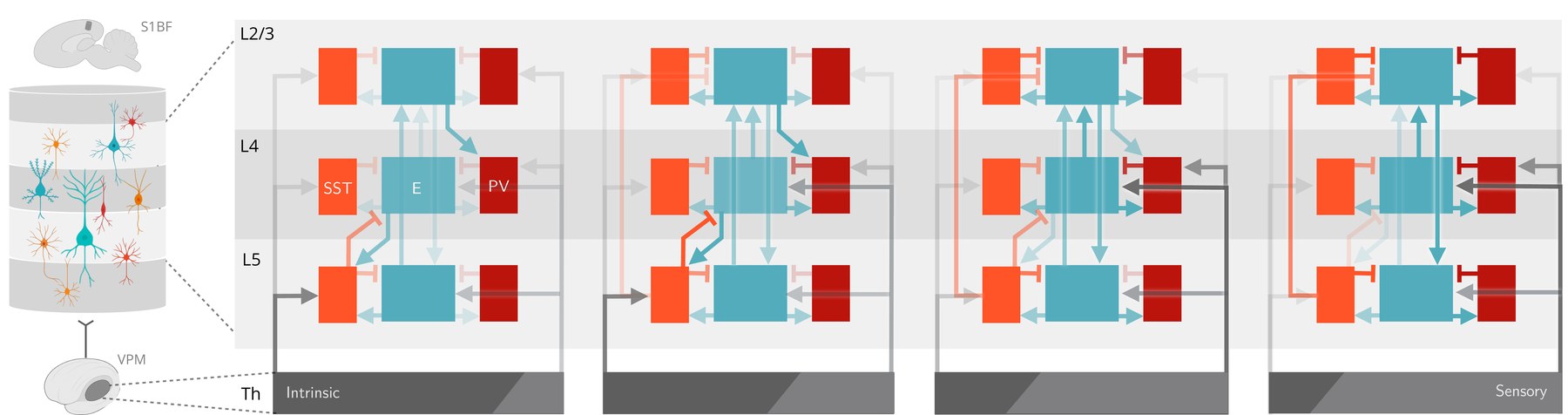
Other systems I've worked on include:
- Representational drift in mouse visual cortex
- Graph rules for chaos in spiking networks
- Sparsity in low-rank recurrent networks
- Beta oscillations in macaque premotor cortex
- Efficient coding in the retina
- Collective behaviour in fruit flies
- Unconscious bias in human decision-making
I did my MSc at ENS Paris, and BSc at the University of Bristol. Between them, I took a year off to travel around Europe to meet with researchers, artists and thinkers, and piece together a map of computational neuroscience "as seen from the inside". I publish as Elizabeth Herbert.
Publications
- 2025Lakhera, S.*, Herbert, E.*, & Gjorgjieva, J. Modeling the emergence of circuit organization and function during development. Cold Spring Harbor Perspectives in Biology 17(2), a041511. *co-first authors
- 2024Bauer, J., Lewin, U., Herbert, E., Gjorgjieva, J., Schoonover, C., Fink, A., Rose, T., Bonhoeffer, T., & Hübener, M. Sensory experience steers representational drift in mouse visual cortex. Nature Communications 15, 9153.
- 2022Herbert, E., & Ostojic, S. The impact of sparsity in low-rank recurrent neural networks. PLOS Computational Biology 18(8), e1010426.
- 2017Ruch, S., Herbert, E., & Henke, K. Subliminally and supraliminally acquired long-term memories jointly bias delayed decisions. Frontiers in Psychology 8, 1542.